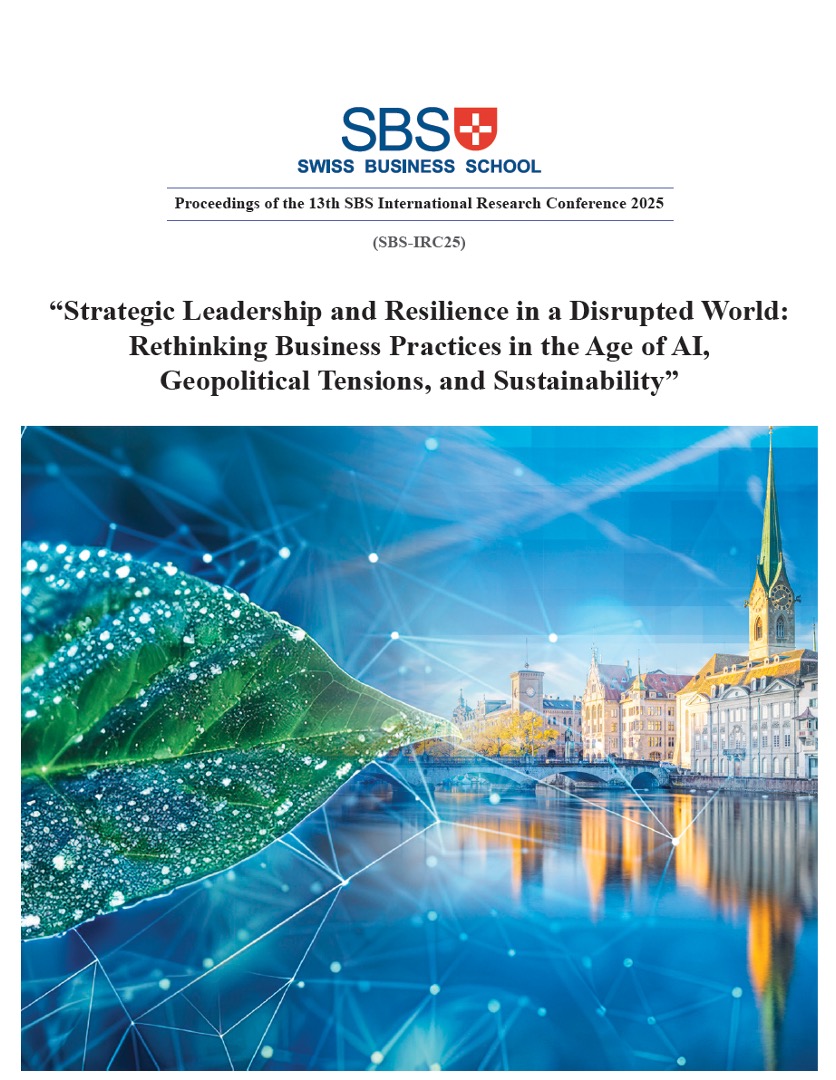
Strategic Leadership and Resilience in a Disrupted World
DOI:
https://doi.org/10.70301/CONF.SBS-JABR.2025.1/1.1Keywords:
Technology & AI Integration; Strategic Leadership; Adaptive Business model; Resilience & Risk Management, SustainabilityAbstract
In an era marked by rapid technological shifts, global uncertainty, and mounting sustainability pressures, strategic leadership and resilience have become vital pillars for long term business success. In today’s volatile and interconnected global landscape, organizations are increasingly confronted with a triad of disruptive forces—artificial intelligence (AI), geopolitical instability, and intensifying sustainability imperatives. These forces not only challenge the effectiveness of conventional business practices but also call into question the very foundations of strategic decision-making and leadership. This paper critically examines the evolving role of strategic leadership in fostering resilience and guiding organizational transformation in response to these disruptions. It argues that the path forward requires a fundamental rethinking of how firms craft, implement, and sustain their strategies in a world marked by rapid technological evolution, political fragmentation, and environmental urgency.
Artificial intelligence has emerged as both an enabler and a disruptor. On one hand, AI offers significant opportunities for optimization, predictive capabilities, innovation, and cost reduction. On the other, it introduces complex ethical dilemmas, heightens competitive pressure, and necessitates substantial changes in workforce structure, governance, and strategic capabilities. Strategic leaders must balance the adoption of AI with considerations of fairness, transparency, and long-term human capital development, recognizing that responsible integration is key to sustaining legitimacy and stakeholder trust.
At the same time, geopolitical tensions—including trade wars, supply chain decoupling, cyber threats, and regulatory divergence—create uncertainty that demands more agile and adaptive strategic responses. Traditional linear planning approaches are insufficient in such an environment. Strategic leadership must be anticipatory and flexible, underpinned by scenario planning, geopolitical intelligence, and the ability to localize strategies across regions while maintaining global coherence.
Sustainability, once peripheral to corporate strategy, is now a core driver of long-term performance and resilience. Environmental, social, and governance (ESG) considerations have become central to investor decisions, consumer preferences, and regulatory frameworks. This paper posits that sustainability should no longer be seen as a constraint, but as a source of innovation, value creation, and risk mitigation. Strategic leaders must reframe sustainability not as compliance, but as opportunity—embedding it into product design, operations, stakeholder engagement, and corporate purpose.
Through a review of contemporary literature and case studies across industries, this study develops a comprehensive strategic leadership framework that aligns these three disruptive domains. We propose the S.T.A.R.S. framework – Strategic leadership, Technology and AI integration, Adaptive Business Models, Resilience and Risk Management, and Sustainability – as a comprehensive approach to guide organizations through volatility and change. The framework emphasizes systems thinking, cross-functional collaboration, ethical foresight, and the cultivation of a resilient organizational culture. The paper also identifies specific leadership competencies—such as adaptive thinking, cognitive agility, and stakeholder empathy—that are essential for navigating today’s complexities.
The central thesis of this work is that resilience in a disrupted world is not merely about bouncing back from crises but about bouncing forward—using disruption as a catalyst for innovation, reinvention, and long-term advantage. Organizations that succeed in the age of AI, geopolitical uncertainty, and sustainability demands will be those led by strategic thinkers capable of bridging short-term action with long-term vision. This paper offers both theoretical insights and practical tools for leaders, scholars, and policymakers seeking to understand and influence the future of strategic leadership in an era defined by systemic transformation.
References
Boal, K. B., & Hooijberg, R. (2001). Strategic leadership research: Moving on. The Leadership Quarterly, 11(4), 515–549.
Brynjolfsson, E., & McAfee, A. (2017). Machine, platform, crowd: Harnessing our digital future. W.W. Norton & Company.
Davenport, T. H., & Ronanki, R. (2018). Artificial intelligence for the real world. Harvard Business Review, 96(1), 108–116.
Eccles, R. G., Ioannou, I., & Serafeim, G. (2014). The impact of corporate sustainability on organizational processes and performance. Management Science, 60(11), 2835–2857.
Hamel, G., & Välikangas, L. (2003). The quest for resilience. Harvard Business Review, 81(9), 52–63.
Heifetz, R., Grashow, A., & Linsky, M. (2009). The practice of adaptive leadership. Harvard Business Press.
Lengnick-Hall, C. A., Beck, T. E., & Lengnick-Hall, M. L. (2011). Developing a capacity for organizational resilience through strategic human resource management. Human Resource Management Review, 21(3), 243–255.
Porter, M. E., & Kramer, M. R. (2011). Creating shared value. Harvard Business Review, 89(1/2), 62–77.
Reeves, M., Lang, N., & Carlsson-Szlezak, P. (2021). The new logic of competition. Harvard Business Review, 99(4), 74–83.
Schoemaker, P. J. H., Krupp, S., & Howland, S. (2013). Strategic leadership: The essential skills. Harvard Business Review, 91(1), 131–134.
Sheffi, Y. (2005). The resilient enterprise: Overcoming vulnerability for competitive advantage. MIT Press.
Teece, D. J. (2010). Business models, business strategy and innovation. Long Range Planning, 43(2–3), 172–194.
Uhl-Bien, M., Marion, R., & McKelvey, B. (2007). Complexity leadership theory: Shifting leadership from the industrial age to the knowledge era. The Leadership Quarterly, 18(4), 298–318.
Westerman, G., Bonnet, D., & McAfee, A. (2014). Leading digital: Turning technology into business transformation. Harvard Business Press.
Barreto, I. (2010). Dynamic capabilities: A review of past research and an agenda for the future. Journal of Management, 36(1), 256–280.
Hollands, T., O’Dwyer, M., & Bennett, R. (2024). How and why organizations build resilience: A critical review. Journal of Business Research, 172, 113456.
O’Reilly, C. A., & Tushman, M. L. (2013). Organizational ambidexterity: Past, present, and future. Academy of Management Perspectives, 27(4), 324–338.
Prayag, G., Chowdhury, M., Spector, S., & Orchiston, C. (2023). Dynamic capabilities and resilience in the tourism sector during crises. International Journal of Contemporary Hospitality Management, 35(2), 578–596.
Ratliff, J., Chen, L., & Wallace, M. (2025). Measuring organizational resilience: Development and validation of the BRT-13. Health Services Management Research, 38(1), 1–12.
Teece, D. J. (2007). Explicating dynamic capabilities: The nature and microfoundations of (sustainable) enterprise performance. Strategic Management Journal, 28(13), 1319–1350.
Weber, Y., & Tarba, S. (2024). Strategic leadership, ambidexterity, and resilience-oriented management control systems. Journal of Management Control, 35(2), 221–240.
Boin, A., & van Eeten, M. J. G. (2013). The resilient organization. Public Management Review, 15(3), 429–445. https://doi.org/10.1080/14719037.2013.769856
Burnard, K., & Bhamra, R. (2011). Organisational resilience: Development of a conceptual framework for organisational responses. International Journal of Production Research, 49(18), 5581–5599. https://doi.org/10.1080/00207543.2011.563827
Duchek, S. (2020). Organizational resilience: A capability-based conceptualization. Business Research, 13(1), 215–246. https://doi.org/10.1007/s40685-019-0085-7
Hillmann, J., & Guenther, E. (2021). Organizational resilience: A valuable construct for management research? International Journal of Management Reviews, 23(1), 7–44. https://doi.org/10.1111/ijmr.12239
Lengnick-Hall, C. A., Beck, T. E., & Lengnick-Hall, M. L. (2011). Developing a capacity for organizational resilience through strategic human resource management. Human Resource Management Review, 21(3), 243–255. https://doi.org/10.1016/j.hrmr.2010.07.001
Linnenluecke, M. K. (2017). Resilience in business and management research: A review of influential publications and a research agenda. International Journal of Management Reviews, 19(1), 4–30. https://doi.org/10.1111/ijmr.12076
Teece, D. J. (2007). Explicating dynamic capabilities: The nature and microfoundations of (sustainable) enterprise performance. Strategic Management Journal, 28(13), 1319–1350. https://doi.org/10.1002/smj.640
Whittington, R., Yakis-Douglas, B., Ahn, K., & Cailluet, L. (2017). Strategic planning as communicative process. Journal of Management Studies, 54(7), 996–1023. https://doi.org/10.1111/joms.12229
World Economic Forum. (2023). Global risks report 2023. Geneva: WEF. https://www.weforum.org/reports/global-risks-report-2023
Zahra, S. A., & Nambisan, S. (2012). Entrepreneurship and strategic thinking in business ecosystems. Business Horizons, 55(3), 219–229. https://doi.org/10.1016/j.bushor.2012.01.004
Additional Files
Published
Issue
Section
License
Copyright (c) 2025 Shoba Krishnan (Author)

This work is licensed under a Creative Commons Attribution 4.0 International License.
Publication Agreement
This Publication Agreement ("Agreement") is made between the author(s) ("Author") and the SBS Journal of Applied Business Research ("Journal"). By submitting a manuscript for publication, the Author agrees to the following terms:
1. Grant of License
The Author retains full copyright ownership of the submitted and published work. The Author grants the Journal a non-exclusive license to publish, distribute, and archive the article in any format or medium, including but not limited to online and print versions.
2. Open Access and Licensing
All articles published in the Journal are fully open access under the Creative Commons Attribution 4.0 International License (CC BY 4.0). This means that:
• The work can be freely used, shared, and adapted by anyone, provided that proper attribution is given to the original Author.
• The full license terms can be found at https://creativecommons.org/licenses/by/4.0/.
• No additional restrictions are placed on the use of published articles.
3. Author Responsibilities and Warranties
The Author guarantees that:
• The submitted work is original and has not been published or submitted for publication elsewhere.
• The work does not infringe on any third-party rights, including copyright, trademark, or proprietary rights.
• All necessary permissions for copyrighted materials used in the manuscript (e.g., figures, tables) have been obtained.
• The manuscript complies with ethical research standards and does not contain any form of plagiarism or falsified data.
4. Editorial and Publication Process
• The Journal reserves the right to perform editorial revisions for clarity, formatting, and consistency while maintaining the integrity of the Author’s work.
• The publication of an article is subject to peer review, and acceptance is not guaranteed upon submission.
5. Retraction and Corrections
• The Journal follows COPE (Committee on Publication Ethics) guidelines and reserves the right to retract, correct, or withdraw an article in cases of misconduct, errors, or ethical concerns.
6. Governing Law
This Agreement is governed by the laws of Switzerland. Any disputes arising under this Agreement shall be resolved in the courts of Zurich, Switzerland.
7. Agreement Acceptance
By submitting a manuscript, the Author acknowledges and agrees to the terms outlined in this Agreement.
Editor-In-Chief
Prof. Dr. Milos Petkovic