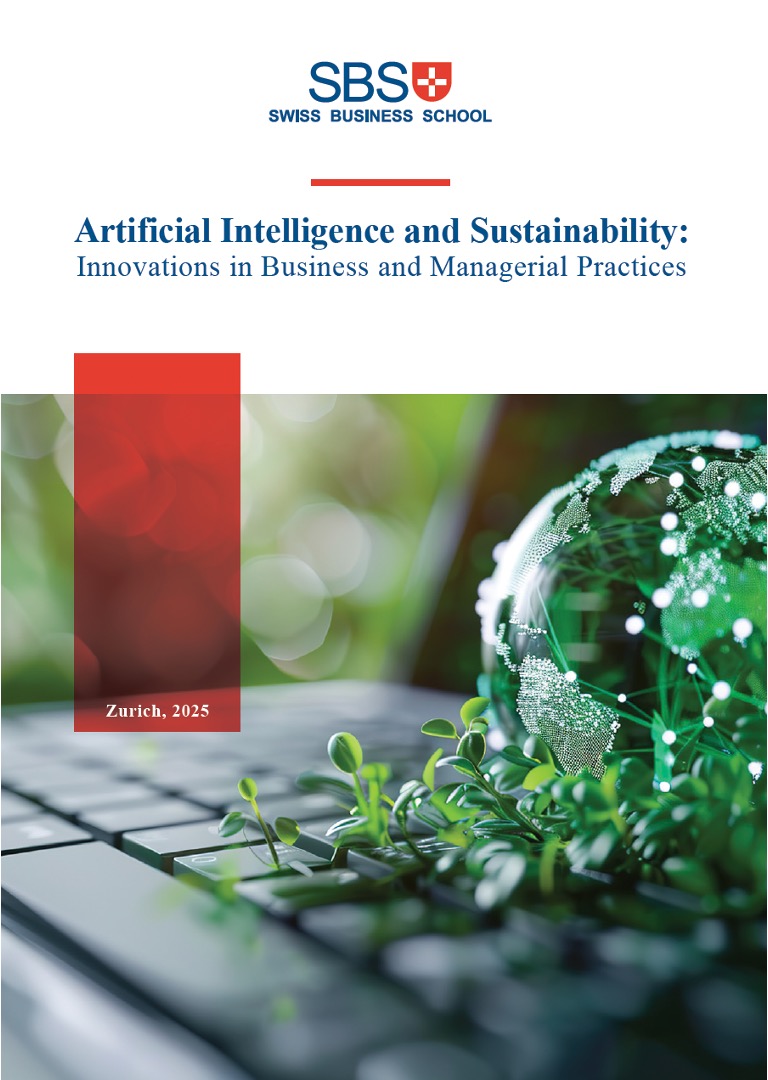
AI Artificial Intelligence, Sustainability and Strategic Leadership
DOI:
https://doi.org/10.70301/SBS.MONO.2025.1.6Keywords:
Artificial Intelligence, Strategic leadership, Ethicality, Transparency, Operations efficiency, Cost saving, Policy makers, Government guidelines, AI experts, Environment Sustainability, Social and Economic impacts, Renewable energy, Carbon emission;Abstract
Artificial Intelligence (AI) has grown drastically in recent years. Organization leadership teams are focusing on analyzing the data through Artificial Intelligence (AI) and deriving it to the constructive decisions. This chapter shall focus on the leadership strategies which are used to develop the business operations by simplifying the model of operations with the support of AI, minimizing the timelines, operation cost and enhancing the speed and accuracy of the results, also aligning the sustainable development goals, reducing carbon emission and footprint, which can be done by adapting the approaches like use of solar and wind (renewable) energy, water and waste management, sustainable agricultural developments, use of preserved biodiversity, respectively depending upon suitability in contributing to the different industries and sectors. This chapter will also focus on the use of generative AI, the positive and challenging impact of the same, also how it can be environmentally friendly, by using renewable energy and moderating emissions. Sustainable Business Practices is important but along with this, ethicality and transparency of data usage, code of conduct, proper documentations, managing and analyzing risk along with the responsible behavior is also significant. AI experts, policy makers, Government guidelines and business leaders need to align, plan and design the strategy which is supporting the concept of AI, sustainable development of the company and leadership teams leading the company’s defined social and economic goals. The chapter will also shed light on scope and suggestions for future positive outcomes.
References
Barney, J. (1991). Firm resources and sustained competitive advantage. Journal of Management, 17(1), 99–120. https://doi.org/10.1177/014920639101700108
Bass, B. M., & Riggio, R. E. (2006). Transformational leadership (2nd ed.). Lawrence Erlbaum Associates.
Bera, A., & O’Neill, R. (2020). Artificial intelligence in agriculture: Applications and challenges. Agricultural Systems, 178, 102721. https://doi.org/10.1016/j.agsy.2019.102721
Binns, A. (2020). The role of artificial intelligence in driving sustainability. Harvard Business Review. https://hbr.org/2020/09/the-role-of-artificial-intelligence-in-driving-sustainability
Cozzolino, A., et al. (2020). Sustainability-driven innovation in the era of artificial intelligence. Sustainability, 12(1), 167. https://doi.org/10.3390/su12010167
Elkington, J. (1997). Cannibals with forks: The triple bottom line of 21st-century business. Capstone.
Harrison, J., et al. (2021). Leveraging AI for sustainable development: Case studies in energy, agriculture, and manufacturing. Journal of Strategic Sustainability, 10(2), 45–62.
Kiron, D., et al. (2021). The role of artificial intelligence in strategic decision-making. MIT Sloan Management Review, 62(3), 22–29.
O’Neil, C. (2016). Weapons of math destruction: How big data increases inequality and threatens democracy. Crown Publishing Group.
Rahman, M. M., Rahman, M. S., & Hossain, G. (2022). Applications of artificial intelligence in energy systems: A comprehensive review. Energy Reports, 8, 739-756. https://doi.org/10.1016/j.egyr.2022.01.014
Teece, D. J., Pisano, G., & Shuen, A. (1997). Dynamic capabilities and strategic management. Strategic Management Journal, 18(7), 509–533. https://doi.org/10.1002/(SICI)1097-0266(199708)18:7<509::AID-SMJ882>3.0.CO;2-Z
Additional Files
Published
Issue
Section
License
Copyright (c) 2025 Neha Ahuja (Author)

This work is licensed under a Creative Commons Attribution 4.0 International License.
Publication Agreement
This Publication Agreement ("Agreement") is made between the author(s) ("Author") and the SBS Journal of Applied Business Research ("Journal"). By submitting a manuscript for publication, the Author agrees to the following terms:
1. Grant of License
The Author retains full copyright ownership of the submitted and published work. The Author grants the Journal a non-exclusive license to publish, distribute, and archive the article in any format or medium, including but not limited to online and print versions.
2. Open Access and Licensing
All articles published in the Journal are fully open access under the Creative Commons Attribution 4.0 International License (CC BY 4.0). This means that:
• The work can be freely used, shared, and adapted by anyone, provided that proper attribution is given to the original Author.
• The full license terms can be found at https://creativecommons.org/licenses/by/4.0/.
• No additional restrictions are placed on the use of published articles.
3. Author Responsibilities and Warranties
The Author guarantees that:
• The submitted work is original and has not been published or submitted for publication elsewhere.
• The work does not infringe on any third-party rights, including copyright, trademark, or proprietary rights.
• All necessary permissions for copyrighted materials used in the manuscript (e.g., figures, tables) have been obtained.
• The manuscript complies with ethical research standards and does not contain any form of plagiarism or falsified data.
4. Editorial and Publication Process
• The Journal reserves the right to perform editorial revisions for clarity, formatting, and consistency while maintaining the integrity of the Author’s work.
• The publication of an article is subject to peer review, and acceptance is not guaranteed upon submission.
5. Retraction and Corrections
• The Journal follows COPE (Committee on Publication Ethics) guidelines and reserves the right to retract, correct, or withdraw an article in cases of misconduct, errors, or ethical concerns.
6. Governing Law
This Agreement is governed by the laws of Switzerland. Any disputes arising under this Agreement shall be resolved in the courts of Zurich, Switzerland.
7. Agreement Acceptance
By submitting a manuscript, the Author acknowledges and agrees to the terms outlined in this Agreement.
Editor-In-Chief
Prof. Dr. Milos Petkovic