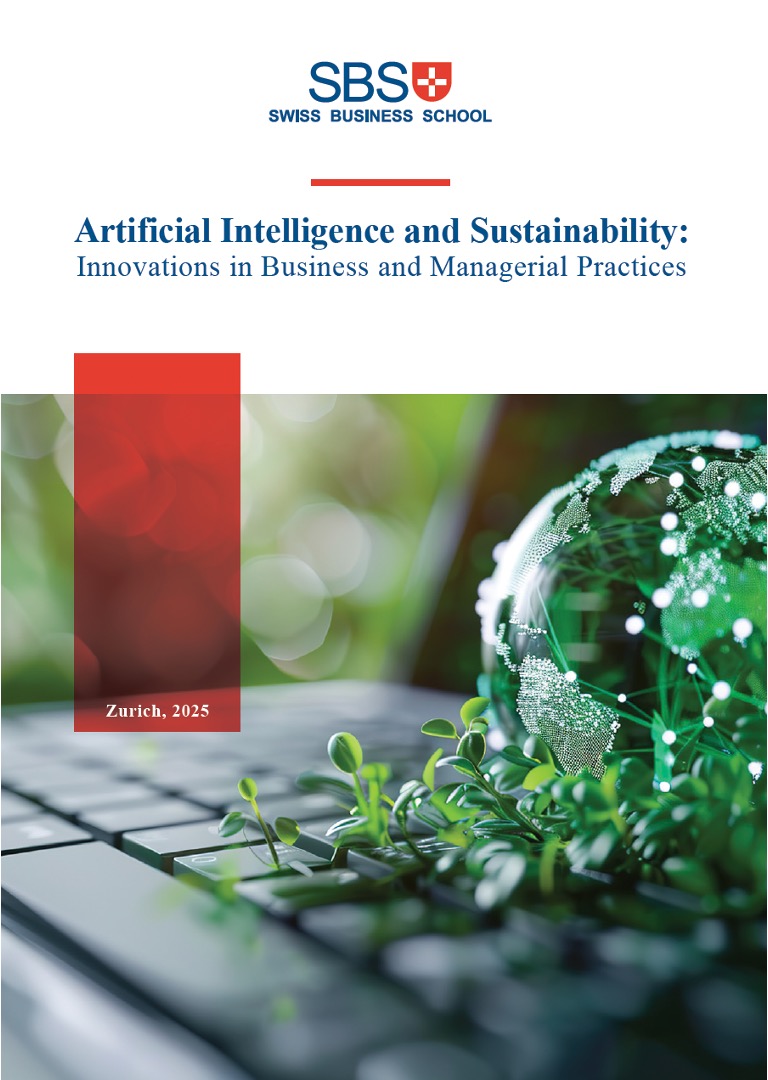
Artificial Intelligence and Sustainability: Innovations in Business and managerial Practices
DOI:
https://doi.org/10.70301/SBS.MONO.2025.1.3Keywords:
Diversity, Inclusion, Creativity, Human and Machines, Artificial Intelligence, Human Resources, and Human Touch;Abstract
Artificial Intelligence (AI) will, more than ever, play a critical role in every aspect of organizational progression and influence decisions across the board. Human, talent, and overall workforce management is no exception to this influence and impact; AI’s influence will be through organizational leadership via guiding decision-making, team management, and innovation processes. As its potential is explored, it becomes clear that leaders must adapt to leverage innovation effectively and address the new ethical and cultural issues they raise. Organizations, leadership, cultures, and pillars of organizational structures and systems must do this while remaining ethical, mindful, and aware of not affecting creativity (INSEAD, 2024). The leadership of any organization must lead with AI while keeping people, mindfulness, ethics, and values, as well as creativity and the human touch at the heart of everything that they do and each AI strategy (AON, 2024). AI has the potential to unleash creativity, foster human connections, imagine new ways of learning, enable the automation of existing tasks, and promote new adaptive tasks that require human ingenuity and empathy. That is quite a list, which raises equal challenges and opportunities (INSEAD, 2024). What is clear is that leaders will remain indispensable in helping their teams and firms negotiate this brave new world. To do so successfully, they must adopt a dual mindset, while helping to maintain and create moments of deep, thoughtful human interactions. Four challenges may arise from AI’s influence and leverage: 1) HR’s operational complexities, 2) data’s readiness, accuracy, and availability, 3) legalities that may arise and conform to compliant approaches, and 4) Manpower’s reactions and behavior against and towards algorithm-based decisions (Jobylon, 2024).
References
AON. (2024). How Artificial Intelligence is Transforming Human Resources and the Workforce. https://www.aon.com/en/insights/articles/how-artificial-intelligence-is-transforming-human-resources-and-the-workforce
Black S., van Esch P. (2021). AI-Enabled Recruiting in the War for Talent. Business Horizons, 64(4), pp513-524. https://www.insead.edu/faculty-research/publications/journal-articles/ai-enabled-recruiting-war-talent
IBMI. (2024). International Business Management Institute. https://www.ibm-institute.com/
IBM. (2024). Artificial Intelligence and a New Era of Human Resources. https://www.ibm.com/think/topics/ai-in-hr
INSEAD. (2024). How Businesses Can Survive the AI “Black Hole”. https://knowledge.insead.edu/strategy/how-businesses-can-survive-ai-black-hole
HBR. (2023). 4 Actions HR Leaders Can Take to Harness the Potential of AI. https://hbr.org/sponsored/2023/11/4-actions-hr-leaders-can-take-to-harness-the-potential-of-ai
HBR. (2024). Where AI Can — and Cannot — Help Talent Management. https://hbr.org/2022/10/where-ai-can-and-cant-help-talent-management
Jobylon. (2024). https://www.jobylon.com/blog/ai-in-hr/
LinkedIn. (2024). Artificial Intelligence (AI) Impact on Human Resources (HR). https://www.linkedin.com/pulse/artificial-intelligence-ai-impact-human-resourceshr-gummudu
Additional Files
Published
Issue
Section
License
Copyright (c) 2025 Kelly Salame (Author)

This work is licensed under a Creative Commons Attribution 4.0 International License.
Publication Agreement
This Publication Agreement ("Agreement") is made between the author(s) ("Author") and the SBS Journal of Applied Business Research ("Journal"). By submitting a manuscript for publication, the Author agrees to the following terms:
1. Grant of License
The Author retains full copyright ownership of the submitted and published work. The Author grants the Journal a non-exclusive license to publish, distribute, and archive the article in any format or medium, including but not limited to online and print versions.
2. Open Access and Licensing
All articles published in the Journal are fully open access under the Creative Commons Attribution 4.0 International License (CC BY 4.0). This means that:
• The work can be freely used, shared, and adapted by anyone, provided that proper attribution is given to the original Author.
• The full license terms can be found at https://creativecommons.org/licenses/by/4.0/.
• No additional restrictions are placed on the use of published articles.
3. Author Responsibilities and Warranties
The Author guarantees that:
• The submitted work is original and has not been published or submitted for publication elsewhere.
• The work does not infringe on any third-party rights, including copyright, trademark, or proprietary rights.
• All necessary permissions for copyrighted materials used in the manuscript (e.g., figures, tables) have been obtained.
• The manuscript complies with ethical research standards and does not contain any form of plagiarism or falsified data.
4. Editorial and Publication Process
• The Journal reserves the right to perform editorial revisions for clarity, formatting, and consistency while maintaining the integrity of the Author’s work.
• The publication of an article is subject to peer review, and acceptance is not guaranteed upon submission.
5. Retraction and Corrections
• The Journal follows COPE (Committee on Publication Ethics) guidelines and reserves the right to retract, correct, or withdraw an article in cases of misconduct, errors, or ethical concerns.
6. Governing Law
This Agreement is governed by the laws of Switzerland. Any disputes arising under this Agreement shall be resolved in the courts of Zurich, Switzerland.
7. Agreement Acceptance
By submitting a manuscript, the Author acknowledges and agrees to the terms outlined in this Agreement.
Editor-In-Chief
Prof. Dr. Milos Petkovic