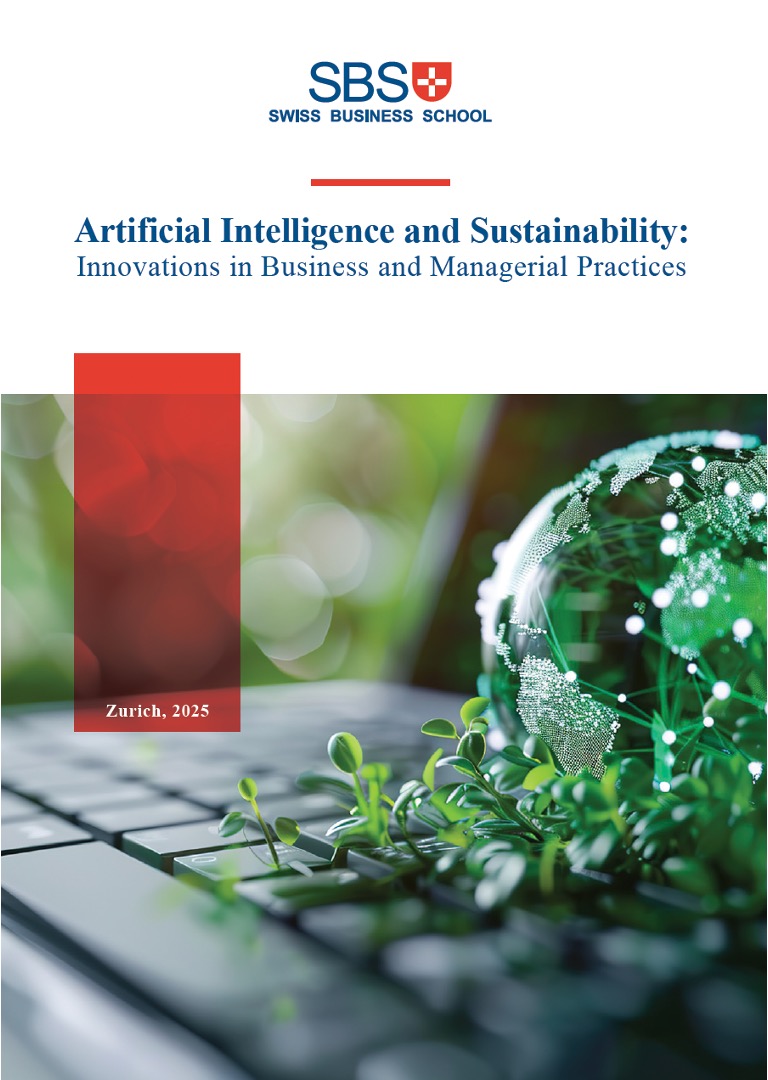
Human-AI Collaboration for Inclusive Growth and Sustainable Development
DOI:
https://doi.org/10.70301/SBS.MONO.2025.1.9Keywords:
artificial intelligence, human resource, sustainability;Abstract
AI is a transformative technology that, when paired with human intelligence, can serve as the foundation of inclusive economic prosperity and sustainable development, rather than just an automation tool. As such, human-AI collaboration is essential for designing responsible AI systems, maximizing resource efficiency, and guaranteeing access to AI-powered opportunities. AI-human synergy will improve innovation, better decision-making and a more sustainable and inclusive economy. We explore the role of AI in achieving the United Nations Sustainable Development Goals (SDGs), using case studies from smart cities, precision agriculture, green supply chains, AI-enabled financial inclusion and workforce augmentation. The conversation emphasizes the need for regulation, outlines ethical dilemmas and discusses the environmental consequences of AI systems. It also examines how AI could be deployed responsibly to meet global challenges, lessen inequalities and augment not replace humans workers. The chapter closes with policy recommendations and a road map by which AI can inform a transition to sustainable business and economic models, as well as to ensure that benefits of AI are equitably shared across industries and communities.
References
Bencsik, A., Horváth, C., & Juhász, T. (2016). Y and Z generations at workplaces. Journal of Competitiveness, 8(3), 90–106.
Amazon. (2023). AI upskilling program: Investing in the workforce of the future. Retrieved from https://www.amazon.com
Brynjolfsson, E., & McAfee, A. (2017). Machine, platform, crowd: Harnessing our digital future. W.W. Norton & Company.
European Union. (2023). The AI Act: Regulating artificial intelligence for ethical deployment. Retrieved from https://europa.eu
IBM. (2023). AI-driven water management solutions in Africa. Retrieved from https://www.ibm.com
McKinsey & Company. (2023). The state of AI in 2023: Generative AI’s breakout year. Retrieved from https://www.mckinsey.com
PwC. (2023). AI’s global economic impact: The $15.7 trillion opportunity. Retrieved from https://www.pwc.com
Russell, S., & Norvig, P. (2020). Artificial intelligence: A modern approach (4th ed.). Pearson.
United Nations. (2022). AI for Sustainable Development Goals (SDGs): Harnessing technology for global progress. Retrieved from https://www.un.org
World Economic Forum. (2023). The future of jobs report 2023: AI and workforce evolution. Retrieved from https://www.weforum.org
Zuboff, S. (2019). The age of surveillance capitalism: The fight for a human future at the new frontier of power. PublicAffairs.
Brynjolfsson, E., & McAfee, A. (2017). Machine, platform, crowd: Harnessing our digital future. W. W. Norton & Company.
Bughin, J., Hazan, E., Ramaswamy, S., Chui, M., Allas, T., Dahlström, P., Henke, N., & Trench, M. (2018). Notes from the AI frontier: Modeling the impact of AI on the world economy.
McKinsey Global Institute. Retrieved from https://www.mckinsey.com
Crawford, K., & Calo, R. (2016). There is a blind spot in AI research. Nature, 538(7625), 311–313. https://doi.org/10.1038/538311a
Dignum, V. (2019). Responsible artificial intelligence: Designing AI for human values. IT Professional, 21(6), 16–21. https://doi.org/10.1109/MITP.2019.2965871
Floridi, L., & Cowls, J. (2019). A unified framework of five principles for AI in society. In Proceedings of the AAAI/ACM Conference on AI, Ethics, and Society (pp. 1–7). https://doi.org/10.1145/3306618.3314234
United Nations. (2021). The age of digital interdependence: Report of the UN Secretary-General’s High-level Panel on Digital Cooperation. United Nations. https://www.un.org/en/digital-cooperation-panel
World Economic Forum. (2020). Unlocking technology for the global goals. World Economic Forum. https://www.weforum.org
Organization for Economic Co-operation and Development. (2021). AI and the future of skills: AI’s role in workforce transformation. OECD Publishing. https://doi.org/10.1787/ae4dcec1-en
Additional Files
Published
Issue
Section
License
Copyright (c) 2025 Nada Ahmed (Author)

This work is licensed under a Creative Commons Attribution 4.0 International License.
Publication Agreement
This Publication Agreement ("Agreement") is made between the author(s) ("Author") and the SBS Journal of Applied Business Research ("Journal"). By submitting a manuscript for publication, the Author agrees to the following terms:
1. Grant of License
The Author retains full copyright ownership of the submitted and published work. The Author grants the Journal a non-exclusive license to publish, distribute, and archive the article in any format or medium, including but not limited to online and print versions.
2. Open Access and Licensing
All articles published in the Journal are fully open access under the Creative Commons Attribution 4.0 International License (CC BY 4.0). This means that:
• The work can be freely used, shared, and adapted by anyone, provided that proper attribution is given to the original Author.
• The full license terms can be found at https://creativecommons.org/licenses/by/4.0/.
• No additional restrictions are placed on the use of published articles.
3. Author Responsibilities and Warranties
The Author guarantees that:
• The submitted work is original and has not been published or submitted for publication elsewhere.
• The work does not infringe on any third-party rights, including copyright, trademark, or proprietary rights.
• All necessary permissions for copyrighted materials used in the manuscript (e.g., figures, tables) have been obtained.
• The manuscript complies with ethical research standards and does not contain any form of plagiarism or falsified data.
4. Editorial and Publication Process
• The Journal reserves the right to perform editorial revisions for clarity, formatting, and consistency while maintaining the integrity of the Author’s work.
• The publication of an article is subject to peer review, and acceptance is not guaranteed upon submission.
5. Retraction and Corrections
• The Journal follows COPE (Committee on Publication Ethics) guidelines and reserves the right to retract, correct, or withdraw an article in cases of misconduct, errors, or ethical concerns.
6. Governing Law
This Agreement is governed by the laws of Switzerland. Any disputes arising under this Agreement shall be resolved in the courts of Zurich, Switzerland.
7. Agreement Acceptance
By submitting a manuscript, the Author acknowledges and agrees to the terms outlined in this Agreement.
Editor-In-Chief
Prof. Dr. Milos Petkovic