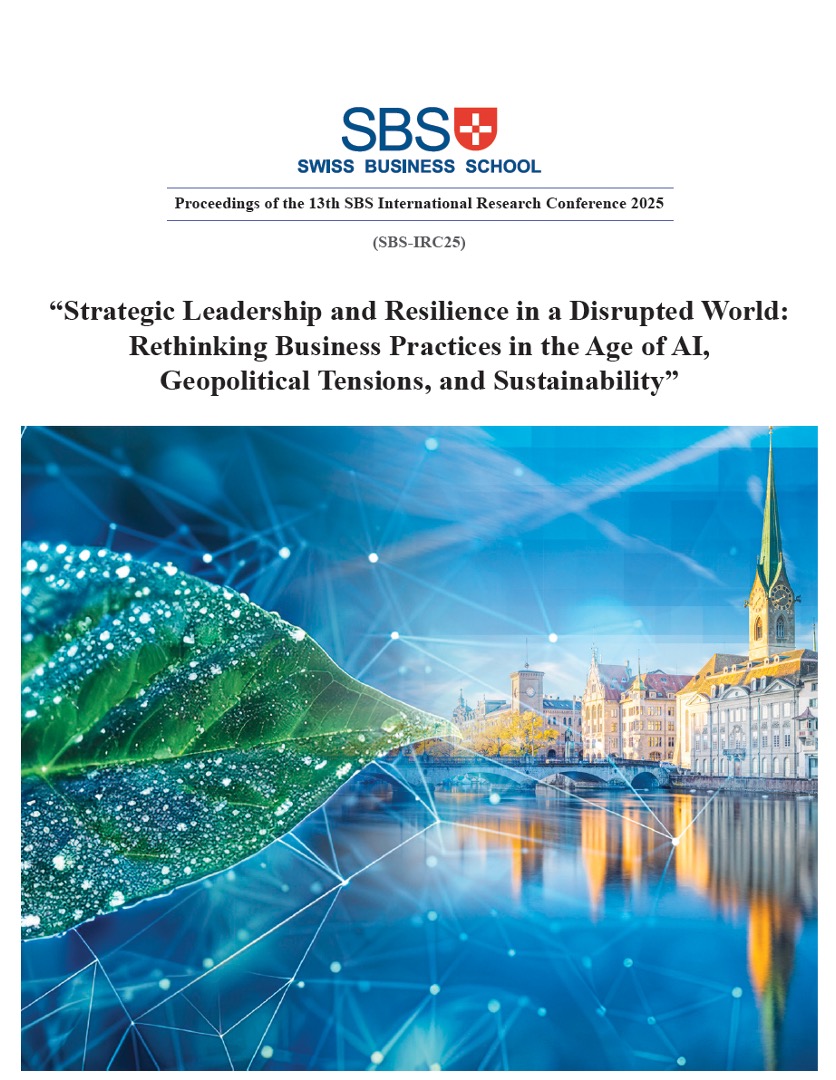
Strategic Leadership and Resilience in a Disrupted World: Rethinking Business Practices in the Age of AI, Geopolitical Tensions, and Sustainability
DOI:
https://doi.org/10.70301/CONF.SBS-JABR.2025.1/1.4Keywords:
Strategic Leadership, Organizational Resilience, Artificial Intelligence (AI) Governance, Sustainability (ESG Integration), Geopolitical DisruptionAbstract
The accelerating pace of technological change, combined with intensifying geopolitical instability and pressing sustainability challenges, has created an environment in which traditional leadership models are increasingly inadequate. This paper examines the evolving role of strategic leadership and organizational resilience in a disrupted global context. Through a conceptual synthesis of recent scholarly contributions, the study highlights how leaders can integrate ethical innovation, agility, and sustainability into organizational strategy. Findings emphasize four imperatives: responsible AI governance, agile resilience, ESG integration, and collaborative ecosystems. Practical illustrations are drawn from contemporary cases such as Microsoft’s responsible AI frameworks, Tesla’s sustainability-driven innovation, and resilience strategies in UAE healthcare. By embedding agility, ethical foresight, and sustainability into leadership practices, organizations can transform disruption into an opportunity for long-term competitive advantage. Implications are discussed for both business leaders and scholars, with recommendations for future empirical inquiry.
References
Brown, M. E., & Treviño, L. K. (2006). Ethical leadership: A review and future directions. The Leadership Quarterly, 17(6), 595–616. https://doi.org/10.1016/j.leaqua.2006.10.004
Delias, P., Falk, M., & Ridderstaat, J. (2023). Crafting impactful papers: Expectations and recommendations for business and management articles. Heliyon, 9(12), e22871. https://doi.org/10.1016/j.heliyon.2023.e22871
Dzwigol, H., & Dźwigoł-Barosz, M. (2024). Research problem formulation in management science. Scientific Papers of Silesian University of Technology Organization and Management Series, 2024(212), 55–66. https://doi.org/10.29119/1641-3466.2024.212.5
Edmondson, A. (1999). Psychological safety and learning behavior in work teams. Administrative Science Quarterly, 44(2), 350–383. https://doi.org/10.2307/2666999
Freeman, R. E. (1984). Strategic management: A stakeholder approach. Pitman.
Garavan, T. N., & McGuire, D. (2001). Competencies and workplace learning: Some reflections on the rhetoric and the reality. Journal of Workplace Learning, 13(4), 144–164. https://doi.org/10.1108/13665620110391097
Kittler, M. (2020). A template and guide to writing academic papers. SSRN Electronic Journal. https://doi.org/10.2139/ssrn.3549317
Kouam, A. (2024). Writing an impactful introduction in business and management research: Avoiding common pitfalls. International Journal of Scientific Research and Management, 12(2), 144–152. https://doi.org/10.18535/ijsrm/v12i02.em07
Lengnick-Hall, C. A., Beck, T. E., & Lengnick-Hall, M. L. (2011). Developing a capacity for organizational resilience through strategic human resource management. Human Resource Management Review, 21(3), 243–255. https://doi.org/10.1016/j.hrmr.2010.07.001
Marin-Garcia, J., García-Sabater, J., & Maheut, J. (2022). Case report papers guidelines: Recommendations for the reporting of case studies or action research in business management. WPOM-Working Papers on Operations Management, 13(2), 1–12. https://doi.org/10.4995/wpom.16244
Öztürk, O., Kocaman, R., & Kanbach, D. (2024). How to design bibliometric research: An overview and a framework proposal. Review of Managerial Science. Advance online publication. https://doi.org/10.1007/s11846-024-00738-0
Sauer, P., & Seuring, S. (2023). How to conduct systematic literature reviews in management research: A guide in 6 steps and 14 decisions. Review of Managerial Science, 17(6), 1899–1933. https://doi.org/10.1007/s11846-023-00668-3
Senge, P. M. (1990). The fifth discipline: The art and practice of the learning organization. Doubleday.
Sutcliffe, K. M., & Vogus, T. J. (2003). Organizing for resilience. In K. S. Cameron, J. E. Dutton, & R. E. Quinn (Eds.), Positive organizational scholarship (pp. 94–110). Berrett-Koehler.Senge, P. M. (1990). The fifth discipline: The art and practice of the learning organization. Doubleday.
Sutcliffe, K. M., & Vogus, T. J. (2003). Organizing for resilience. In K. S. Cameron, J. E. Dutton, & R. E. Quinn (Eds.), Positive organizational scholarship (pp. 94–110). Berrett-Koehler.
Additional Files
Published
Issue
Section
License
Copyright (c) 2025 Aziz Alzeqri (Author)

This work is licensed under a Creative Commons Attribution 4.0 International License.
Publication Agreement
This Publication Agreement ("Agreement") is made between the author(s) ("Author") and the SBS Journal of Applied Business Research ("Journal"). By submitting a manuscript for publication, the Author agrees to the following terms:
1. Grant of License
The Author retains full copyright ownership of the submitted and published work. The Author grants the Journal a non-exclusive license to publish, distribute, and archive the article in any format or medium, including but not limited to online and print versions.
2. Open Access and Licensing
All articles published in the Journal are fully open access under the Creative Commons Attribution 4.0 International License (CC BY 4.0). This means that:
• The work can be freely used, shared, and adapted by anyone, provided that proper attribution is given to the original Author.
• The full license terms can be found at https://creativecommons.org/licenses/by/4.0/.
• No additional restrictions are placed on the use of published articles.
3. Author Responsibilities and Warranties
The Author guarantees that:
• The submitted work is original and has not been published or submitted for publication elsewhere.
• The work does not infringe on any third-party rights, including copyright, trademark, or proprietary rights.
• All necessary permissions for copyrighted materials used in the manuscript (e.g., figures, tables) have been obtained.
• The manuscript complies with ethical research standards and does not contain any form of plagiarism or falsified data.
4. Editorial and Publication Process
• The Journal reserves the right to perform editorial revisions for clarity, formatting, and consistency while maintaining the integrity of the Author’s work.
• The publication of an article is subject to peer review, and acceptance is not guaranteed upon submission.
5. Retraction and Corrections
• The Journal follows COPE (Committee on Publication Ethics) guidelines and reserves the right to retract, correct, or withdraw an article in cases of misconduct, errors, or ethical concerns.
6. Governing Law
This Agreement is governed by the laws of Switzerland. Any disputes arising under this Agreement shall be resolved in the courts of Zurich, Switzerland.
7. Agreement Acceptance
By submitting a manuscript, the Author acknowledges and agrees to the terms outlined in this Agreement.
Editor-In-Chief
Prof. Dr. Milos Petkovic